Friday, October 10, 2008

Vix Pervenit (On Usury and Other Dishonest Profit)

I follow Tom's suggestion and I leave here a couple of words on what I was saying yesterday regarding the relationship between commodity fetishism and the Catholic ban on usury. I do it even if, most probably, as someone said: "it's madness".

This will be indeed a very short post - just a bunch of confuse ideas caused by the accidental reading of an encyclical of Pope Benedict XIV called Vix Pervenit, On Usury and other dishonest profit. Nevertheless I thought it could be interesting to try to follow Marx in his speculations about the relationship between commodity fetishism and religious fetishism. In particular, I found myself wondering if one could see the Catholic ban on usury as a revealing instance in which our two favourite fetishisms, coming finally to recognize each other as conflicting belief systems, engaged in an hegemonic struggle over workers' fantasies and desires.
I try to explain myself. When confronted with the challenge of showing us the secret workings of that mysterious thing that is the commodity Marx can't find anything better than dragging us on a flight up in the misty realm of religious faith. He then shows us, side by side, two different types of fetishism: religious fetishism and commodity fetishism.
"There it is a definite social relation between men, that assumes, in their eyes, the fantastic form of a relation between things. In order, therefore, to find an analogy, we must have recourse to the mist-enveloped regions of the religious world. In that world the productions of the human brain appear as independent beings endowed with life, and entering into relation both with one another and the human race. So it is in the world of commodities with the products of men’s hands."
I would suggest that the Catholic Church was most certainly aware of the fetishistic character of the commodity, of the super-human power of the trinket which not only dance and move through the market but even seems to reproduce itself through the mysterious workings of finance, banking and usury.

What is it happening today in that most magic realm of finance?
At first sight, what we have is matter giving birth to matter, wealth springing up most mysteriously from the hands of the capitalist. Or better, what we have is matter destroying itself out of stubborn free will, disappearing, collapsing, imploding in spectacular explosions.

Isn't there something truely diabolic in the art of financial speculation? God is marginalized, pushed on the margin by this act of creation: He neither blesses the capitalist with the miracle of creation, nor He curses him with the necessity to work. The capitalist as thus a new fetish: money. A new godly thing which finally frees him from the "original sin" opening up a new Eden where work, sacrifice, muscular strain is forgotten. Value is not a product of labour - "congealed labour-power" - value comes from value, directly, out of magic multiplication.

I mean, the Church clearly had to get a little bit upset about that. And that is probably the reason why usury was condemned by many theologians and effectively banned after the Council of Trento (1545-1563). As far as I know St.Thomas Aquinas has written quite a lot on usury and his positions seem to point exactly to the fetishistic character of usury. St Thomas quotes Aristotle as saying that "to live by usury is exceedingly unnatural". Practicing usury is diabolic since it means nothing else than "to make money simply by having money" without neither work or risk implied. This in total disregard both of the labor theory of value and, most importantly, of the word of God: "In sudore vultus tui ovesceris pane: you will earn your bread by the sweat of your brow". (Genesis: 3,19)
Only God can make tables dance, reproduce and turn on their heads. Not the market!

It seems to me, thus, that the Church, and Aquinas in particular, had a fairly good grasp on the dangers of commodity fetishism. And they weren't the only: Judaism and Islam equally apply some kind of ban on usury (but I don't know much about it).

It seems like religion is an extremely jealous creature, it doesn't like fellow fetishisms coming alone. But what about commodity fetishism, isn't it a far more social and tollerant lad? And aren't they united in their "cultus of abstract man"?

Strange relationships...

(For reference: http://www.ewtn.com/library/ENCYC/B14VIXPE.htm ; http://en.wikipedia.org/wiki/Thought_of_Thomas_Aquinas#Aquinas_and_usury ; http://en.wikipedia.org/wiki/Usury ).

Monday, October 06, 2008

Hi (great post by Judy below; anyone else want to comment?)

Thought this might be of interest; I have a tendency to read Marx as a philosopher, and wish I had a greater facility with the economic stuff:

Public Meeting

Tuesday October 21st

7pm Conway Hall, Red Lion Square

MARX and the credit crunch

Istvan Mezsaros, author of Beyond Capital

Chris Harman, editor, International Socialism journal

Richard Brenner, author of The Credit Crunch - a Marxist Analysis

A global credit crunch. Banks collapsing. Prices soaring. Recession looming. Conventional economic theory appears to have no coherent explanation. Government stumps up hundreds of billions to rescue the bankers - and demands that working people's pay be held down and spending cut on public services. At this meeting, three Marxist writers examine the roots of this great crisis in the nature of capital itself. Tracing the current crisis to its origins, they show how workers can resist paying the price for a crisis they never made, and set out the case for systemic change.

Sunday, October 05, 2008

Where's Wally?

After attending the lecture and seminar for this course I felt rather adventurous. I'm particularly relieved that we're encouraged to read the text afresh and for ourselves (in so far as that is possible).

However, after reading what Luckacs had to say about totality as opposed to particulars and analysing fragments, I'm confused about our approach to the text.

I understand the distinction between analysis and presentation and that Lukacs criticises certain economists for focusing on Marx's formulae / the particulars of the text and their failure to understand history as a totalising process, rather than the coherence of his analysis as a WHOLE.

However, while Marx's analysis as a whole is fascinating and revolutionary (literally), what I find equally if not more compelling is to read the text in order to explore the different images, references and subplots that are contained within it (have I missed the point if I call these images/metaphors/sentences fragments - or even trinkets?????) and the ambivalence/contradictions/disjunctures/ambiguities contained within these trinkets themselves and what happens or what you can see when you put them next to each other.

After the lecture I felt really inspired and that I could approach this text as MYSELF(s) but then I wondered if I am supposed to be looking for Wally after all- I mean, looking for the analysis, the 'point' of the text, what he MEANS to say about capitalism, rather than the relationship between what he means to say and the way he says it. I felt that Lukacs didn't want Marx to be read with too much attention to all of the other characters on the page (the vampires etc), only on where Wally (the main analysis) was located.

But then maybe I'm the wally and I'm taking Lukacs too personally.

Saturday, October 04, 2008

Housmans Radical Booksellers

I just wanted to shamelessly promote an endangered bookshop in Kings Cross:

http://www.housmans.com/index.htm

They have loads of stuff on anarchism, situationalism, marxism- yet they have no particular allegiance to anything (which perhaps puts them in a rather precarious position). They run lots of events which are free and at which they serve wine and afterwards people stand around and talk about Syd Barrett and Guy Debord.

Thursday, October 02, 2008

links

...Thought I might add a couple of links too:

Firstly, I wanted to remind people to look at the Marxists.org library:

http://www.marxists.org/

I've found it to be enormously useful in the past, as they have just about everything there for free (including all sort of other stuff: Clausewitz, Lao Tse, Machiavelli, Kant, Hegel, etc.). very useful if you're trying to track down a quotation, check something of just want free access to a text.

I thought this next one might be useful to some of you: when I first started trying to make sense of Capital I found one book (reccomended by John) to be patricularly useful: Felton Shortall's The Incomplete Marx. It's very dry, but very helpful, as it basically gives you a run through of Volumes 1, 2 and 3. It stresses the centrality of class struggle and revolution to Marx's work, and describes Capital as an unfinished project. There's a copy in the library (I think), but you can get in free from the library of a site called Libcom:

http://libcom.org/library/incomplete-marx-felton-c-shorthall

I know Felton, so if anyone is particularly keen I can probably put you in touch.

I'm not sure if this next one is a good idea or not, but I thought it might be worth mentioning the theory discussion forum at Libcom:

http://libcom.org/forums/thought

I've used that forum on several occasions; sometimes to run ideas past people, to ask questions, or just to relieve boredom. There are almost always online reading groups of Volume 1 that you can look at or participate in, as well as endlessly convoluted and heated debates about the more confusing aspects of what Marx was trying to say and do. Please don't take anything that anyone says there as gospel, and obviously don't reference postings when writing an essay (at least not unless you're doing some complicated anthropological study of Marxist internet forums). That said, I thought discussion there might provide a helpful supplment to the seminars (should anyone find themselves to be really eager).

Cheers

Tom

Marx and Philosophy Society

The next Marx and Philosophy Society meeting takes place on the 25th of October. Some of the talks look good (particularly Chris Arthur's and Andrew Chitty's, both of whom are worth seeing in their own right):

http://www.marxandphilosophy.org.uk/

Anarchist Bookfair

The London anarchist bookfair takes place on the 18th of October. It's the biggest annual gathering in the U.K. of anarchists and associated lefty activist types, and is always worth a visit; loads of books, thousands of leaflets and pamphlets, and lots of talks and events. Details can be found at the link below:

http://www.anarchistbookfair.org/

Historical Materialism conference

The Journal Historical Materialism will be holding their annual conference next month, at the School of African and Oriental Studies. They haven't got the timetable set up on their website yet, but it's bound to be worth a visit; last year's event was good, and involved some very interesting papers.


MANY MARXISMS

HISTORICAL MATERIALISM ANNUAL CONFERENCE 2008

7-9 November 2008

School of Oriental and African Studies, Central London

Organised in collaboration with the Isaac and Tamara Deutscher
Memorial Prize Committee and with Socialist Register.


Organised in association with the International Initiative for the
Promotion of Political Economy, the journal Situations and the Journal
of Agrarian Change, and with the assistance of the Faculty of Law and
Social Sciences of SOAS.


Ever since its foundation in 1997, Historical Materialism has sought
to contribute to the intellectual recomposition of the global Left by
serving as an international venue for critical Marxist research. The
journal's initial wager - that Marxism remains a vital, and
heterogeneous and many-faceted political and theoretical tradition -
has been borne out in a conjuncture where Marxist thinkers have amply
demonstrated the critical resources at their disposal (witness recent
debates on imperialism and neoliberalism). Within the academy, the
facile dismissal of Marxism seems to have run out of steam, and the
attitudes of new generations of students and researchers have changed
accordingly. Marxist intellectuals are no longer simply forced to
survive in hostile conditions or to retreat into isolated academic
subcultures, despite an often adverse global political context. In
this setting, they face new challenges, which this conference seeks to
address


How can we develop the plurality of Marxist debates, fields and
schools without making concessions to eclecticism, narcissism or
compartmentalisation? How do we square the concrete multiplicity of
Marxisms with the strong commonalities in intellectual vocabularies,
theoretical sources and political aims? Hasn't the question of the
diversity of Marxism - of many Marxisms - accompanied the tradition’s
entire development, a testament both to its internationalist horizon,
and to the inexhaustible potential of its many critical insights and
conceptual formulations? What strategies can allow us to confront, and
perhaps overcome, some of the disparities or even misunderstandings
born of these processes of differentiation?


Having tried to foster a form of critical cosmopolitanism and debate
in past conferences, bringing together thinkers working in different
fields, and out of different traditions, this year's Historical
Materialism conference wants to emphasise problems and opportunities
raised by the existence of 'Many Marxisms'. To this end, it aims to
take stock of recent developments in Marxist thought, surveying the
most vibrant recent debates; to confront critical moments in the
historical development of Marxism; to identify crucial concepts and
areas of research that can cut across any preconceived academic
specialisation or geographical isolation of Marxism; to reflect on the
ways in which Marxism has and continues to intervene in mainstream
intellectual debates; and, finally, to generate a space in which the
outlines of the many twenty-first century Marxisms may be delineated.


THE FULL TIMETABLE AND ONLINE REGISTRATION DETAILS WILL BE AVAILABLE
SOON


For more details, please contact: historicalmaterialism@soas.ac.uk

THEMES COVERED WILL INCLUDE:

Approaching Passive Revolutions * Art and Capitalism * Aspects of
Imperialism * Base and Superstructure * Beyond Global Value Chain
Analysis in Commodity Studies * Bolshevism: Yesterday and Tomorrow *
Capitalism / Knowledge Capitalism * Capitalism and Architecture *
Climate Change, Sustainability and Socialism * Contemporary Radical
Thought and Marxism: Agamben, Holloway, Zizek * Early Modern
Capitalism * Ecological Crisis and Marxist Theory * Everyday Life *
Finance and Neo-Liberalism * Financialisation and Crisis * Food Crisis
* From the Grundrisse to Capital * Future of World Capitalism *
Historical Materialism and Late Development * Historiography in the
Development of Marxism * International Financial Institutions * Is
Today's Capitalism Actually-Existing Barbarism? * Labour-Process and
Resistance * Latin American Left Today * Learning from Enemies and
Rivals: Schmitt, Strauss, Weber * Life, Politics & Capitalism * Many
Marxisms and India * Many Marxisms: Key Figures * Many Marxisms:
Problems and Polemics * Marx and Fetishism * Marx on World Economy and
World Politics * Marxism and Cinema: Film Noir and Neo-Noir * Marxism
and Metropolitics * Marxism and Philosophy * Marxism and the Sciences
* Marxism Outside the West * Marxism, Feminism and Women’s Politics *
Marxisms and Literature * Marxisms and Religion * Marxisms and
Southern Africa * Marxisms and Violences: Gender and Race * Marxist
Theories of Practice * Modes of Foreign Relations * Monetary Policy
and Banking under Neoliberalism * Money * Negativity and Revolution *
North East Asian Marxisms and Socialisms * On the Concept of Surplus
Populations * Perspectives from Althusser * Perspectives from Marx’s
‘Jewish Question’ * Philosophies of Revolt and Revolution *
Philosophy in the Early Marx * Political Categories of Marxism *
Political Economy and Economics Today * Politics of the Promotion of
Global Competitiveness * Racism, Class and Politics * Restructuring,
Capital and Labour * Revolutionary Politics in the Middle East *
Sexual Liberation: Historical Materialist Approaches * Situationism at
the Limits: Must we Burn Debord? * Socialism in Search of an Economic
System * State in the Bolivarian revolution * Theories of Class *
Theories of Imperialism * Time, Temporality, History * Transformations
in the Neoliberal State * Uneven and Combined Development: Towards a
Marxist Theory of ‘the International’? * US Financial Power in
Crisis * Utopianism * Value: Political and Economic Dimensions *
‘Western’ Marxism and the Anti-Colonial World/Intellectuals *
Windows on Empire: Perspectives from History, Culture and Political
Economy * Workerism: a Generation Later *

Thursday, December 13, 2007

The Eighteenth Brumaire of George W. Bush


The Second Empire, or The Eighteenth Brumaire of George W. Bush
Michael Hardt

We seem doomed to historical repetition. In fact, there is a surplus of ghosts from the past wandering through our current scene. The difficulty is to cast out the false specters and see which great historical events and figures are really being repeated today.

In some respects, the Iraq war and the current global mission of the US government seem to repeat the old European imperialist projects. The present efforts not only to impose new regimes in Afghanistan and Iraq but also more generally to remake the political landscape of the Middle East and even "reshape the global environment" are conceived and presented using the old terms of the civilizing mission of European powers. President Bush might imagine himself donning the cloak of the great noble imperialists, educating the savages and bringing civilization to the world. We must have the courage to help them, he says, and they will thank us later. Or, in a more venal vein, the efforts to control the vast oil fields in Iraq and the Middle East certainly recall numerous imperialist wars to accumulate wealth, such as the British attempts a century ago in the Boer War to gain control of the great South African gold mines - blood for gold yesterday, blood for oil today.

Despite these resemblances, however, the old imperialisms do not help us understand what is central in our contemporary situation. These comparisons are really just ill fitting clothes that hide what is going on underneath. The real historical repetition is much closer to home. The United States is now repeating the Gulf War of 1991, certainly, but that is really merely an element in a much more important historical repetition: the coup d'Etat within the global system - a new 18eme Brumaire, this time a repetition of father and son, not uncle and nephew. By coup d'Etat here I mean a usurpation of power within the ruling order by the unilateral, monarchical element and the corresponding subordination of the multilateral, aristocratic forces.

The coup d'Etat of Bush father was conceived at the time as the creation of a new world order. Soon after the fall of the Berlin Wall and the collapse of the bi-polar cold war order, the first Gulf War helped establish the terms of the new global power structure. The United States, as the sole remaining superpower, would take precedence over all other powers, but it would not rule the world alone. The US role in the first Empire navigated a path that combined superiority and collaboration. The United States would exercise monarchical powers, especially in military matters, but within simultaneously collaborate in a broad global power system constituted by a network of powers of varying capacities and forms, including the other dominant nation-states, particularly Europe and Japan, along with major capitalist corporations, supranational organizations such as the UN, the World Bank, and the IMF, and numerous others. The essential feature of the first Empire, once again, is that the monarchical superiority of the United States did not contradict or obstruct the participation of the various aristocratic forces in the global power system.

The coup d'Etat of Bush son, which often goes under the name of unilateralism, takes one step further in the concentration of global power in the hands of the monarchical United States. What is abundantly clear in the new US doctrine of pre-emptive strikes and global political restructuring is that the United States is attempting to subordinate radically all aristocratic powers. The United States believes it can rule the world alone or, rather, with merely the aid of passive vassals. Other powers are thus advised to support it and follow its lead, not so much because they are necessary but really for their own good, because failure to follow the US lead will weaken them further and ultimately make them irrelevant.

While Bush son plays the young Bonaparte, then, the United Nations and the European nation-states, particularly France and Germany, find themselves in the position of the 19th century French bourgeois parliamentary parties, insisting on multilateralism against the unilateralism of the Emperor. This is the real historical repetition. In fact, the struggle between the United States and the United Nations, the US efforts to divide and weaken Europe, and the conflicts within NATO are much closer to the essential core of the current developments than even the war on Iraq. This is where the hierarchy of the second Empire - new world order 2 - is being worked out today.


Every historical repetition, however, comes with a difference, and it is not merely that the first event has the weight of a tragic creative transformation whereas the second presents a grotesque masquerade. The coup d'Etat of Bush son resembles that of the father in that both of them seek to concentrate greater power in the hands of the United States. In the first Empire, however, the monarchical role of the United States in the new world order was balanced by a broad aristocratic participation in a network of numerous different powers. Today this dual nature of Empire - US superiority plus broad collaboration - seems to have broken down completely. On one side, a united Europe, the United Nations, and other multilateral powers threaten to pose an effective alternative to the United States and undermine its global superiority. (One should not underestimate the threat posed by the Euro to the global monetary monopoly of the dollar.) On the other side, Bush the son's second Empire attempts to separate the United States from all other powers and render collaboration unnecessary. From both sides we can see that the concord of monarchic and aristocratic ruling powers of the first Empire has been shattered, and seems today increasingly impossible.

In response to the coup d'Etat and the formation of the second Empire in 19th century France, when the forces of revolution seemed at the lowest point, Marx sought reasons for optimism. He did not advocate, of course, taking the side of the multilateralist bourgeois parties against the unilateralist Emperor. Rather he saw the conflicts among the ruling powers as a passage through purgatory, in which the seemingly inexistent revolutionary forces were merely tunneling underground, hidden from view, waiting for the right time to spring forth. We too have no intention of taking sides with any of the forces struggling for power at the pinnacle of the global hierarchy - the United States, Europe, the United Nations, Blair, Chirac, etc. Today, however, different from Marx's time, the forces of revolution are working in full view. They matured during the first Empire and enter into the second with growing powers. This is perhaps the most important difference, a difference that may free us from the tragic cycle of historical repetition.

Published in Global Magazine

Monday, December 03, 2007

Berkeley and the Mass Ornament


After the references to Siegfried Kracauer in the seminars last week I thought this was worth posting.

An amazing clip from Bubsy Berkeley's Gold Diggers of 1935.


This is the perfect example of the 'mass ornament' as discussed by Kracauer.

Sunday, December 02, 2007

Hardt on Charlie Rose

Thanks to Carina for sending this. The bit with Hardt starts after 32 minutes.


As well as Empire as a pdf.

Friday, November 30, 2007

Dreampolitik

Here's an inteview with Stephen Duncombe, author of Dream: Re-imagining progressive politics in an age of fantasy.

It's at www.againstthegrain.org 11.05.07

Mon 11.05.07| Playing the Game

Much of the Left ignores or denigrates things like celebrity media, violent video games, and slick advertising. But according to Stephen Duncombe, there's much progressives can learn from commercial culture and popular fantasies. In this follow-up interview, the author of Dream reveals what the Left can learn from the best-selling video game Grand Theft Auto.

From banlieues to South Bronx via Watts


First here's a short text by Baudrillard on the 2005 riots in France.
http://newleftreview.org/?view=2595

Second a text by the Situationists on the 1965 Watts Riots.
http://www.bopsecrets.org/SI/10.Watts.htm

Third a Percee P video featuring footage from the film 80 Blocks from Tiffany's, which I'm going to try to get a bootleg copy of over the break. Email if interested.

Wednesday, November 28, 2007

Lonely Planet and Iraq

I haven't gotten a chance to watch this documentary yet myself, but apparently it's the first to reveal that the American officials responsible for reconstructing Iraq were consulting a Lonely Planet guide from 1994 for key information. Thought it might be interesting for those of you writing or interested in issues surrounding tourism.

Friday, November 23, 2007

Sex and Capitalism

This interview sounds relevant as a follow up to the discussion around Fortunati's text yesterday.

Mon 11.19.07| Liberating Sex
What does capitalism do to sex and sexuality? And what does socialist theory have to say about sexual desire and sexual arrangements? In his essay in Toward a New Socialism, Michael Hames-Garcia reviews various socialist perspectives on gender and sexuality, with an emphasis on same-sex desire. He also comments on certain trends in gay and lesbian organizing since the 1970s.


Against the Grain is often quite good and it's worth subscribing to the podcast if one does that sort of thing.

Burroughs and Century of the Self

Thanks for Marc for sending a link to this feature-length Burroughs documentary.

I also noticed a link on the Google video site to Adam Curtis' Century of the Self. This is definitely worth watching, as is his documentary The Power of Nightmares. I don't know how much they have to do with each other but would could perhaps think about them in terms of control. Here's a link to Deleuze's short, readable text 'Postscript on Control Societies'.

Tuesday, November 20, 2007

Rowdy Roddy Piper and Ideology Critique


From Zizek's lecture at Historical Materialism:
John Carpenter’s They Live (1988) is one of the neglected masterpieces of the Hollywood Left. In its most memorable scene, the hero, an unemployed construction-worker who lives in an LA shanty-town, puts on a pair of glasses he found in an abandoned church, and notices that a billboard in front of him now simply displays the word "OBEY," while another billboard urges the viewer to "MARRY AND REPRODUCE." He also sees that paper money bears the words "THIS IS YOUR GOD," etc.- a beautifully-naïve mise-en-scene of ideology: through the critico-ideological glasses, we directly see the Master-Signifier beneath the chain of knowledge – we learn to see dictatorship IN democracy. When the hero tries to convince his friend to put the glasses on, the friend resists, and a long violent fight follows, worthy of Fight Club (another masterpiece of the Hollywood Left). The violence staged here is a positive violence, a condition of liberation – the lesson is that our liberation from ideology is not a spontaneous act, an act of discovering our true Self. We learn in the film that, when one looks for too long at reality through critico-ideological glasses, one gets a strong headache: it is very painful to be deprived of the ideological surplus-enjoyment. To see the true nature of things, we need the glasses: it is not that we should put ideological glasses off to see directly reality as it is”: we are “naturally” in ideology, our natural sight is ideological.


Sunday, November 18, 2007

Sean Eisenstein


Here is some commentary by Darren:

Heidegger says "Thus, where Enframing reigns, there is /danger/ in the highest sense." Then he quotes Holderlin, "But where danger is, grows the saving power also."

As the 'beings of light' erupt through the mechanical video frame, we suggest that the salvation might literally manifest itself visually.

An old article of mine makes some sense in this light:
http://www.darrenflint.com/text/Eisenstein%20Feedback.doc

"Quite a different (though no less curious) application of the Eisenstein feedback method is the experimental generation and observation of autonomous ‘beings of light.’ ... These orbs may remain stable for several days at a time. Those with a rich history of interaction may appear to be stable for minutes or hours at end before suddenly and unexpectedly erupting with flashes, self-generated ‘appendages’ or rapid changes in colour or size. It is curious to note that such complex behaviours are associated with many visually-comparable hallucinogenic phenomena including hypnagogic visuals and ‘earth lights.’ It seems fair to say that these strange properties of Eisenstein feedback warrant further investigation."

Thursday, November 08, 2007

Heidegger on Marx


This seems to be the transcript (taken from the youtube site)...

Richard Wisser: ... Do you think philosophy has a social mission?

Heidegger: No! One can't speak of a social mission in that sense! To answer that question, we must first ask: "What is society?" We have to consider that today's society is only modern subjectivity made absolute. A philosophy that has overcome a position of subjectivity therefore has to say no in the matter.

Another question is to what extent we can speak of a change of society at all. The question of the demand for world change leads us back to Karl Marx's frequently quoted statement from his Theses on Feuerbach. I would like to quote it exactly and read out loud: "Philosophers have only interpreted the world differently; what matters is to change it." When this statement is cited and when it is followed, it is overlooked that changing the world presupposes a change in the conception of the world. A conception of the world can only be won by adequately interpreting the world.

That means: Marx's demand for a "change" is based upon on a very definite interpretation of the world, and therefore this statement is proved to be without foundation. It gives the impression that it speaks decisively against philosophy, whereas the second half of the statement presupposes, unspoken, a demand for philosophy.

Wednesday, November 07, 2007

The Simpsons on Outsourcing

Thought I'd post this in the main blog so everyone definitely sees it. It's particularly relevant to the last 200 or so pages of Capital but worth looking at now regardless. Thanks to Claudia for posting it:

Friday, November 02, 2007

Must Crush Capitalism

Links galore


I'm trying to remember most of the books, films, and sites mentioned yesterday. Remind me if I forgot something:

Thanks Ban for the link to the Class Against Class library, featuring texts by Negri, Tronti, Panzieri, and Cornelius Castoriadis from the French group Socialisme Ou Barbarie (of which Lyotard was also a member).

The book I mentioned in class yesterday on the development of Taylorism in France is From Taylorism to Fordism: A Rational Madness by Bernard Doray. They've got it in the library. Gramsci has a key essay called 'Americanism and Fordism' in his Prison Notebooks. Anyone looking for a fictional representation should look at Jeffrey Eugenides' novel of incest and hermaphroditity (and Fordism) Middlesex (he also wrote The Virgin Suicides).

Call Centre Communism is available for download here...
http://www.nadir.org/nadir/initiativ/kolinko/lebuk/e_lebuk.htm

...and is critiqued by Riff Raff here:
http://www.riff-raff.se/en/6/callcenters_en.php

On a lighter note, the book I mentioned by Philip Willan, Puppetmasters: The use of political violence in Italy, is taken up in the context of 9.11:

'Willan turned up numerous indications that the famed Toni Negri was indeed involved with the Red Brigades, but most likely as an operative of the Italian secret services, run by the FBI (not the CIA; apparently there was a bit of a turf war going on between the two agencies. Just as the lie that the CIA does not operate within the U.S. has been exposed, so too has the notion that the FBI does not operate abroad). Although now considered a "martyr" by the Left, a victim of a frame-up by the Italian judicial system, the more likely fact is that Negri is still working for the integrated U.S./NATO/Italian secret services, as an informer and a "disinformation" agent. Isn't it amazing that Harvard University Press has published his "bestseller" Empire (co-authored with Michael Hardt) — Harvard publishes books by convicted terrorists? Well, yes, maybe, if the publication is part of a special operation to undermine the anticapitalist movement. The book has been ably dissected and exposed for the objectively reactionary obfuscation that it is. Among the crimes we know Negri is guilty of is successfully infecting Marxian critique with postmodernism. It is probably no coincidence that "autonomist Marxists"; refuse to see the real significance of September 11, and the coming globalization of the "strategy of mass terror through mass murder".'

Ullmer's film noir Detour (1945), one the cheapest and most profitable films ever made apparently:

Monday, October 29, 2007

Slaughtered Lambs


I'm not sure how much the categories and concepts we've encountered thus far help us to think through this example, but I thought it was worth posting a link to an article in today's Guardian regardless. The article is being framed in terms of 'animal welfare', but I think it's interesting to think about it in terms of (so-called free) markets, supply and demand, and price/value.

Sunday, October 28, 2007

The Politics of Utopia

Here is a link to the pdf of the Jameson essay, 'The Politics of Utopia', that I mentioned in the seminar. Anyone interested in sci-fi or utopia should definitely check out his Archaeologies of the Future, which features chapters on Le Guin, Philip K. Dick, and William Gibson's Pattern Recognition.

Friday, October 26, 2007

Marxism vs. Neoclassical economics


In light of Masashi's presentation yesterday that asked some important questions about the differences between marxist economics and neoclassical economics I found a link that might be useful:

A book by Wolff and Resnicks, Economics: Marxian versus Neoclassical. I haven't looked through it myself but they have it at Senate House. There is a review of the book in Monthly Review as well.

If anyone has any other reading recommendations please email me and I can add them or put them in the comments.

Dance of the Dialectic


In the second seminar yesterday I mentioned Bertell Ollman's Dance of the Dialectic as a good book on Marx's methodology and dialectics as a whole. There are a few chapters of it available on his NYU web site here.

Gold Farming

This is another interesting case study to test Marx's categories against:


Friday, October 19, 2007

The Sacred Conspiracy


A nation already old and corrupted which will courageously shake off the yoke of its monarchical government in order to adopt a republican one will only be able to maintain itself by many crimes, for it is already in crime, and if it wants to pass from crime to virtue, that is, from a violent to a gentle state, it will fall into an inertia which will soon result in its certain ruin.
SADE

That which had a political face and imagined itself political will unmask itself one day and reveal itself to be a religious movement.
KIERKEGAARD

Today solitary, you who live separated, you will one day be a people. Those who appointed themselves will one day form an appointed people – and it is from this people that will be born the existence that surpasses man.
NIETZSCHE

What we have undertaken should be confused with nothing else, cannot be limited to the expression of an idea and even less to what is justly considered art.

It is necessary to produce and to eat: many things are needed that are yet nothing, and this is equally the case with political agitation.

Before fighting to the bitter end, who thinks to leave his place to men it is impossible to look upon without feeling the need to destroy them? But if nothing could be found beyond political activity, human greed would meet nothing but the void.

WE ARE FEROCIOUSLY RELIGIOUS, and insofar as our existence is the condemnation of all that is recognized today, an internal requirement wants us also to be imperious.

What we are undertaking is a war.

It is time to abandon the world of the civilized and its light. It is to late to want to be reasonable and learned, which has led to a life without attractions. Secretly or not, it is necessary to become other, or else cease to be.

The world to which we have belonged proposes nothing to love outside of each individual insufficiency: its existence is limited to its convenience. A world that can’t be loved to death – in the same way a man loves a woman – represents nothing but personal interest and the obligation to work. If it is compared with worlds that have disappeared it is hideous and seems the most failed of all of them.

In those disappeared worlds it was possible to lose oneself in ecstasy, which is impossible in the world of educated vulgarity. Civilization’s advantages are compensated for by the way men profit by it: men of today profit by it to become the most degraded of all beings who have ever existed.

Life always occurs in a tumult with no apparent cohesion, but it only finds its grandeur and reality in ecstasy and ecstatic love. He who wants to ignore or neglect ecstasy is a being whose thought has been reduced to analysis. Existence is not only an agitated void: it is a dance that forces us to dance fanatically. The idea that doesn’t have as object a dead fragment exists internally in the same way as does a flame.

One must become firm and unshakeable enough that the existence of the world of civilization finally appears uncertain. It is useless to respond to those who are able to believe in this world and find their authorization in it. If they speak it is possible to look at them without hearing them, and even if we look at them, to only “see” that which exists far behind them. We must refuse boredom and live only on that which fascinates.

On this road it would be vain to move about and to seek to attract those who have vague impulses, like those of passing the time, laughing, or becoming individually bizarre. One must advance without looking back and without taking into account those who don’t have the strength to forget immediate reality.

Human life is defeated because it serves as the head and reason of the universe. Insofar as it becomes that head and reason it accepts slavery. If it isn’t free, existence becomes empty or neuter, and if it is free, it is a game. The earth, as long as it only engendered cataclysms, trees, and birds was a free universe; the fascination with liberty became dulled when the earth produced a being who demanded necessity as a law over the universe. Man nevertheless remained free to no longer respond to any necessity. He is free to resemble all that is not he in the universe. He can cast aside the idea that it is he or God who prevents everything else from being absurd.

Man escaped from his head like the condemned man from his prison.

He found beyond him not God, who is the prohibition of crime, but a being who doesn’t know prohibition. Beyond what I am, I meet a being who makes me laugh because he is headless, who fills me with anguish because he is made of innocence and crime. He holds a weapon of steel in his left hand, flames like a sacred heart in his right hand. He unites in one eruption birth and death. He is not a man. But he isn’t a god, either. He is not I, but he is more I than I: his belly is the labyrinth in which he himself goes astray, led me astray, and in which I find myself being he, that is, a monster.

What I think and represent I didn’t think or represent alone. I am writing in a small cold house in a fishing village; a dog has just barked in the night. My room is next to the kitchen of Andre Masson, who is moving happily about and singing. At the very moment I am writing he has put on the phonograph a recording of the overture of “Don Giovanni.” More than anything else, the overture of “Don Giovanni” ties what is given me of existence to a challenge that opens up a ravishment outside of the self. At this very instant I look upon that headless being, made up of two equally strong obsessions, become “Don Giovanni’s Tomb.” When a few days ago I was in this kitchen with Masson, sitting with a glass of wine in my hand while he, suddenly imagining his own death and that of his kin, his eyes fixed, suffering, almost crying out that death had to become an affectionate and passionate death, crying out his hatred for a world that made weigh even on death its worker’s hand, already I could no longer question that the lot and the infinite tumult of human life are open not to those who exist like poked out eyes, but to those who are like clairvoyants, carried away by an upsetting dream that could not belong to them.

Georges Bataille 1936

Bataille's Tombstone

Georges Bataille
1897-1962

Those substances where the eggs, germs and maggots swarm not only make our hearts sink, but also turn our stomachs. Death does not come down to the better annihilation of being - of all that I am, which expects to be once more, the very meanings of which, rather than to be, is to expect to be (as if we never received being authentically, but only the anticipation of being, which will be and is not, as if we were not the presence that we are, but the future that we will be and are not); it is also that shipwreck in the nauseous. I will rejoin abject nature and the purulence of anonymous, infinite life, which stretches forth like the night, which is death. One day this living world will pullulate in my dead mouth.

Thursday, October 18, 2007

Death by a Thousand Cuts


I've kept the image small for the feint of heart. If you click on it you'll see a bigger version. More images can be found here.

The image was sent to Bataille in 1925 by Adrien Borel. 'The torture victim was Fu Chou Li, guilty of murdering Prince Ao Han Ouan. The emperor's leniency granted that he should not be burned as decreed, but cut to pieces, into a hundred pieces: cut up alive. Georges Dumas may have been and Adrien Borel certainly was present at this execution on 10 April 1905, and brought back photographs of it.' (From Surya's biography, p. 93)

I still can't find the bit I paraphrased in class though. I'll keep looking.

Bataille on Crustaceans


Crustaceans. – One day, Gérard de Nerval went for a stroll in the gardens of the Palais-Royal with a living lobster on a leash. The idlers crowded around him, flabbergasted and roaring with laughter at the strange retinue. One of his friends having asked him why he was making such a fool of himself, Nerval replied: ‘But what are you laughing at? You people go about readily enough with dogs, cats and other noisy and dirty domestic animals. My lobster is a gentle animal, affable and clean, and he is at least familiar with the wonders of the deeps!’
A painter friend of mine said one day that if a grasshopper were the size of a lion it would be the most beautiful animal in the world. How true that would be of a giant crayfish, a crab enormous as a house, and a shrimp as tall as a tree! Crustaceans, fabulous creatures that amaze children playing on beaches, submarine vampires nourished on corpses and refuse. Heavy and light, ironic and grotesque, animals made of silence and of weight.
Of all the ridiculous actions men take upon themselves, none is more so than shrimping. Everybody has seen that elderly gentleman, bearded and red-faced, a white piqué hat on his head, wearing an alpaca jacket, his trousers rolled up to his thighs, a wicker basket on his belly, his shrimping-net at the ready, hunting shrimps in a rock-pool for his dinner. Woe betide the poor shrimp that lets itself be caught! In desperation she wriggles, she slides, she flutters in the triumphant fingers. Elastic animal flower, graceful and lively as mercury, petal separated from the great bouquet of the waves. She is also a woman. Who has not heard of La Môme Crevetteı?
Among crustaceans, the crab known as the ‘sleeper,’ the image of eternal sleep, is the most mysterious, the most deceitful, the shiftiest. It hides under rocks and its mobile eyes watch for passing prey with a cruel malice. It walks sideways. It combines every fault. There are men who resemble it.
The crayfish and the lobster are nobles. They are cultivated like oysters and tulips. They are present at all human ceremonies: political banquets, wedding breakfasts and wakes.
All these beasts change their carapaces, grow old, harden, make love and die. We do not know whether they suffer or if they have ideas concerning ethics and the organization of societies. According to Jarry it would appear that a lobster fell in love with a can of corned beef…
Crustaceans are boiled alive to conserve the succulence of their flesh.

Georges Bataille (Taken from Encyclopedia Acephalica) Translated by Iain White

Erik Satie


Here's a link to some Erik Satie mp3s.

Thursday, October 11, 2007

For a Ruthless Criticism of Everything Existing

Here's a great letter by the young Marx to Arnold Ruge from 1843, often published under the name 'For a ruthless Criticism of Everything existing'. I thought it was quite relevant to today's discussions about the Marxism(s) radical self-critique.

For a Ruthless Criticism

The reform of consciousness consists only in making the world aware of its own consciousness, in awakening it out of its dream about itself, in explaining to it the meaning of its own actions. Our whole object can only be – as is also the case in Feuerbach’s criticism of religion – to give religious and philosophical questions the form corresponding to man who has become conscious of himself.

Hence, our motto must be: reform of consciousness not through dogmas, but by analysing the mystical consciousness that is unintelligible to itself, whether it manifests itself in a religious or a political form. It will then become evident that the world has long dreamed of possessing something of which it has only to be conscious in order to possess it in reality. It will become evident that it is not a question of drawing a great mental dividing line between past and future, but of realising the thoughts of the past. Lastly, it will become evident that mankind is not beginning a new work, but is consciously carrying into effect its old work.

In short, therefore, we can formulate the trend of our journal as being: self-clarification (critical philosophy) to be gained by the present time of its struggles and desires. This is a work for the world and for us. It can be only the work of united forces. It is a matter of a confession, and nothing more. In order to secure remission of its sins, mankind has only to declare them for what they actually are.

Assorted links from today's seminars


Steve McQueen's Gravesend (2007) defetishizing coltan?


Darwin's Nightmare defetishizing Nile perch?

Wednesday, October 10, 2007

Fukuyama and the End of History


Thought I'd provide a link to the infamous 'End of History' essay by Francis Fukuyama that Derrida refers to several times. At the very least it's interesting for capturing a certain zeitgeist.

'The End of History?'

Fukuyama's biography is quite interesting. He was one of the founders of Project for a New American Century, the infamous neo-conservative think thank in the US, but has since split with the movement and even written a book attacking them.

Friday, October 05, 2007

Welles Hearst Capital

In reading Capital, if anything about beginnings should be considered necessary, it might be good just to start with what is immediately at hand. There is much much discussion and theory about this, and its probably naïve to simply say that materialism might start with things themselves, but why not start with the objects, commodities, souvenirs or detritus of our lives? There surely is enough stuff of which to take account in our contemporary world. Plenty of junk. Marx himself has much to say on waste and shit, and in volume three of Capital it becomes crucial (see here)

But we are not at volume three as yet, by any means, though it is a key to the beginning of volume one, where Marx starts with a immense collection of commodities, its is also crucial that materialism as material-ism would have to take account of all this stuff from the perspective of the whole, of totality (Lukacs). This will never be easy or straightforward – an impossible accounting, which must nevertheless be our aim. Even if documentation of all this stuff is forever incomplete and that in all the varied and multiple efforts, interpretation is, or should be, always contested, to do so still betrays a totalizing ambition. We might also call this a reckoning to come. The collection is messianic, the collector divine (Benjamin).

But that is to get ahead of things a little, the task here is to start to read a text, and then to relate it to our present conjuncture.

There are many possible starts.

I want to begin with something, or even someone, who might seem the total antithesis of the celebrated critic of capitalism. Marx was not a rich man, however well bred, well married, well educated, he was in and out of the pawn shop, knew a lot, intimately, about debt, borrowing, credit, and – as is very well known – relied upon a certain moneybags called Freddy Engels very often to get by. Engels though, whatever his peculiar foibles in taking up with two sisters, riding to hounds, effecting a mourning jacket and partiality to fine liqueurs, does not deserve to be lampooned as much as the figure with which I want to begin. I choose a character from the not too far removed history of Capitalism, though glossed through a film – I have in mind the life of William Randolph Hearst. Moneybags. As portrayed by Orson Welles in the film Citizen Kane.

Kane is (stuff about snow globes... as in post here and here).

...
Is it possible to reclaim Citizen Kane from all the readings that have passed over it so much? What residue will need to be cleared away so as to see this film anew? Is that even possible? So many biographies of Welles, but an oblique angular take on this overwritten film can perhaps still reveal something about our perspective today.
...

Hearst, however, cannot be reclaimed. Conrad suggests that Hearst papers created both the gossip column and celebrity (Conrad 2OO3:145). Andre Bazin Points out that the controversy over Kane as Hearst was a consequence of the rivalry between Hearst gossip columnist Louella Parsons and her rival Hedda Hopper. (Bazin 1958/1991:57). Conrad also notes, a page earlier, that Welles had written a forward to Marion Davies posthumously published memoir of her time with Hearst at San Simeon.

Was Hearst’s hostility to Kane reason for the industry to fear exposure, through Hearst papers, of Hollywood’s foibles – sex, payola – or rather its employment of ‘aliens at the expense of American labour’ (Leaming 1985:209)? His support for the working man may well have got him called communist in his youth, but it was always a misnomer.

The importance of rumour in the reception of Kane is clear, but what then of the unspoken exclusions in the Hearst story, the bits of narrative not voiced: Hearst as moneybags plundering the material culture of the world, the arrogance of his taking photos in Luxor where the flash damages the art of millennia...

Hearst thought WW1 a financial venture for Wall Street tycoons and his defence of regular soldiers, even deserters, and pro-Irish anti-imperialists was impressive – for example his campaign in support of British diplomat Roger Casement who was eventually hung for seeking German military support for Irish independence. Such campaigning was however not without financial benefit to Hearst’s own purse in the form of ever growing newspaper sales to those who approved of his anti corruption stance. His position on WW2 entailed a meeting with Hitler, but an abstentionism that became a liability. He rapidly became an advocate of anti-communism in the post WW2 era and had campaigned against pro-Soviet U. S. Films from the early forties, such as 'Mission to Moscow' and 'North Star' (Pizzitola 2002:409).

Hearst, an anti-communist, muck-raking, armaments and finance capital moneybags with a vendetta and a deep resentment (Rosebud)? What then of his concern about ‘alien’ labour? What of his early 'investigative' journalism? Despite denials by Hearst that he orchestrated it, Kane, the film, was branded communist, only saw restricted release, got bad early press, and took several years before being recognised the 'greatest film of all time' etc etc... the rest is cinema history. Welles was investigated by FBI agent Hoover (Pizzitola 2002:398) and his directing career never recovered, despite The Magnificent Ambersons and Touch of Evil, he was forever dogged by studio interference and funding troubles.

So lets find that image from the film that encodes it all - a hammer end Sickle on the façade of the Inquirer (see accompanying still). Then the multiple perspectives of the Kane film can be twisted to do allegorical service for a reading of Capital ("hat tip Rough Theory"). Immediately following the newsreel sequence that (re)starts the the film after Kane's snow globe death, the camera moves through a neon sign and down through a glass window to Susan's table and the first of five or six interviews which structure the rest of the film. These are not consecutive, temporally concurrent, and can even be contradictory, they do not add up to an explanation of the life of Kane, yet by the end, when the ice of the snow globe has turned to the fire of the furnace that consumes all that collected junk, we do perhaps know a little more than before, can examine things in a more nuanced way, and we maybe even get to know something of Hearst.
The different windows on the story of Kane also offer an allegorical way into reading Marx’s Capital – the initial newsreel section something like the commodity fetish chapter, a platform that warns, as does the very first sentence, that things are not what they appear, that the wealth of societies in which the capitalist mode of production prevails only presents itself as an immense collection of commodities

Although the film begins and ends with the No trespassing Sign, it is Welles I think who does want, and wants us, to trespass. His camera passes through the chain mesh, and again through various windows and signs to examine and inquire. This is something like the metaphoric architecture that governs the presentation of Das Kapital. The theatrical references to drawing back curtains (before the wizard of Oz, duex ex machina), the ocular, vision and camera lucida that ‘at first look’… implies always a second, and third, look, the ghost commentary so beloved of Derrida, and much more.


JH - Oct 2007

Bazin, Andre 1950 Orson Welles

Leaming, Barbara 1985 Orson Welles, London: Weidenfeld and Nicholson

Conrad, Peter 2003 Orson Welles: the Stories of His Life, London: Faber and Faber.

Pizzitola, Louis 2002 Hearst Over Hollywood: Power, Passion and Propaganda in the Movies, New York: Columbia University Press.

Derrida on Ghosts


From Ghost Dance

Thursday, October 04, 2007

Capital the Unfinished Masterpiece

Hello everyone. Welcome to the 2007 blog.

Sorry to start with a recycled post but I think this article from The Guardian serves as a quite good introduction to a reading of Capital. It discusses Capital in relation to Balzac's The Unfinished Masterpiece.

'The poet of Dialectics'

Tuesday, January 30, 2007

Marcuse

LENIN'S TOMB has posted a Danish documentary about Marcuse, his support for the radical movements of the 1960s, and his clash with Governor Ronald Reagan. It includes commentary by people like his student Angela Davison (his involvement helping kick down doors in occupations of the university senate at UCSD etc) , and he himself talks about branding, planned obsolescence and alienation. Fred Jameson is in it, and there is an amusing section of attempts by conservatives to buy out Marcuse's job contract. Its an hour long - but worth a Look. Ahh, he paid anonymously for the door he smashed. Strange. The bit with the Marine Recruiter is funny too - very topical still.

Wednesday, December 13, 2006

The Greeks vs. The Germans

Thanks to Neville for sending this round...


Surely Marx wouldn't have been so contemplative?

Immaterial Labour and Empire

Two great texts on immaterial labour and Empire respectively. The first is by Steve Wright that wrote Storming Heaven and the second is by Brian Holmes, who has recently done some interesting stuff on the clash between the weapon-petro dollars alliance and the techno-merger dollars alliance in contemporary capitalism.

http://info.interactivist.net/article.pl?sid=05/12/27/0513241&mode=nested&tid=9
http://info.interactivist.net/article.pl?sid=05/09/27/131214&tid=9

Monday, December 11, 2006

Multitude

Just in case anyone is still reading this and that this anyone is interested in the concept of the multitude...

http://www.ephemeraweb.org/journal/4-3/4-3index.htm

Saturday, December 09, 2006

Bougainville


Occasionally I update on Bougainville stuff (here and here and here) but the latest I have is this (and someone certainly should dissertate on the topic...):

This interview first ran around 0549 GMT


By James Attwood

Of DOW JONES NEWSWIRES


SYDNEY (Dow Jones)--Papua New Guinea's government expects to agree terms with Bougainville authorities next year to lift a moratorium on mining in the battle-scarred island and resume operations the following year.

Give us two years and mining will restart in the Panguna mine," PNG mining minister Sam Akoitai told Dow Jones Newswires Tuesday.

Anglo Australian miner Rio Tinto Plc. (RTP) shut the massive Panguna copper and gold mine in May 1989 after repeated attacks on infrastructure and workers by secessionist rebels.

Speaking on the sidelines of a PNG mining conference in Sydney, Akoitai said both the Bougainville autonomous government and foreign investors are keen to resume activities in the minerals-rich South Pacific island once fiscal arrangements are agreed.

"Bougainville is a place where every man and woman will swim across to," he said, when asked about the current level of investor interest.

"I've been approached by many many companies who are interested in doing exploration in Bougainville and also companies interested in talking about Panguna," he said.

"But my approach would be I'd rather work with the devil I know than getting somebody new to come in and start again," he said, referring to Rio Tinto subsidiary Bougainville Copper Ltd. (BOC.AU)

"I've had the opportunity to work with Bougainville Copper for nine years and think they're doing a very good job."

Besides holding the position of PNG national mining minister, Akoitai is also the parliamentary member for Central Bougainville.

Panguna produced about 180,000 tons of copper a year to rank as the world's third-largest copper mine. It remains closed despite a 1998 cease-fire and the formation of an autonomous island government.

Any decision on resuming mining at the dismantled operation is estimated to cost around US$1 billion.

Before any decision can be taken, however, stakeholders must complete a review of new fiscal and operating terms for exploration and mining on the island, Akoitai said.

The long-delayed review process is expected to begin in the first quarter of next year and take "months" to complete, he said, adding the benefits for Bougainville would have to be significantly better than current terms.

"It's an issue close to me. I'm from Bougainville and I also represent the electorate where the mine is. I would want the review process to be concluded quickly so we can decide the future of mining in Bougainville."

"The whole reason the government in Bougainville asked for this review process to began is so we can sort out the outstanding issues and then perhaps start mining from a clean sheet."

Benefits for the local community would have to be in line with new benchmarks of modern mines, he said, without elaborating.

Akoitai said Australia's Ord River Resources Ltd. (ORD.AU) and Gallipoli Mining Pty Ltd are among companies to make recent approaches to authorities on the possibility of exploring in Bougainville.

-By James Attwood, Dow Jones Newswires; 612-8235-2957;

Tuesday, December 05, 2006

The Spotnicks

Hardt on Iraq

Many argued that the US unabashed unilateralism post-9.11 refuted many of Hardt and Negri's claims in Empire. Here's an editoral Hardt wrote in the Guardian in the build up to the war...

http://www.guardian.co.uk/comment/story/0,,861942,00.html

All of Empire Online

Militant Esthetix

Lots of stuff on Benjamin, Adorno, and Frank Zappa among others...

http://www.militantesthetix.co.uk:80/

Saturday, November 25, 2006

Marx's bottom

If you're not already thinking of Marx as an eccentric and lovable uncle I hope this will do the trick...

Taken from Francis Wheen's Marx's Dad Kapital: A Biography

'By the end of 1865 Das Kapital was a manuscript of 1,200 pages, a blotted mess of crossings-out and indecipherable squiggles. On New Year's Day 1866 he sat down to make a fair copy, "licking the infant clean after long birth pangs". It took just over a year. Even liver trouble and carbuncles couldn't thwart him: he wrote the last few pages standing at his desk when an eruption of boils on the bottom made sitting too painful. Engel's experienced eye immediately spotted certain passages in the text where the carbuncles had left their mark, and Marx agreed that they might have given the prose a rather livid hue. "At all events, I hope the bourgeoisie will remember my carbuncles until their dying day," he cursed. "What swine they are!" The boils disappeared as soon as he complted the last page. "I always had the feeling," Engels told him, "that that damn book, which you have been carrying for so long, was at the bottom of your misfortune, and you would and could never extricate yourself until you had got it off your back." Feeling as voraciously fit as 500 hogs", Marx set off for Hamburg in April 1867 to deliver the manuscript and oversee its printing...'

Friday, November 24, 2006

Caliban and the Witch


Here's an audio interview with Silvia Federici, author of Caliban and the Witch: Women, the Body and Primitive Accumulation

http://aud1.kpfa.org/data/20060711-Tue1200.mp3

Societies of Control


With all the talk of discipline and control recently I've been thinking a lot about Deleuze's short text 'Postscript on the Societies of Control'. Definitely worth looking at and thinking about in terms of the shift between 19th century and 21st century London, work houses and MAs, industrial capitalism and digital capitalism.

http://www.spunk.org/texts/misc/sp000962.txt

Wednesday, November 22, 2006

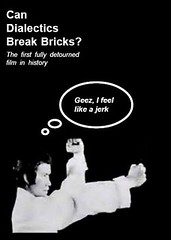
Can Dialectics Break Bricks?


Worth watching if you can get it to work!

http://greylodge.org/gpc/?p=82

Burroughs films

http://www.ubu.com/film/burroughs.html

www.ubu.com is great!

Friday, November 17, 2006

Scary books


The ten most harmful books of the 19th and 20th Centuries...
http://www.humanevents.com/article.php?print=yes&id=7591

(The photo is from a Harry Potter book burning in New Mexico.)

Wednesday, November 15, 2006

Heidegger and Technology


More links to essays on Heidegger and Technology than you can shake a stick at...

http://www.webcom.com/~paf/hlinks/techlinks.html

Tuesday, November 14, 2006

The Young Marx in fine form

I thought this short text from 1844 was interesting in relation to the Heidegger bit and some of the stuff that's come up in class with Feuerbach and The Essence of Christianity. (There's italics all over the original text so it may be use following the link and the bottom to read it.)

The profane existence of error is discredited after its heavenly oratio pro aris et focis has been disproved. Man, who looked for a superhuman being in the fantastic reality of heaven and found nothing there but the reflection of himself, will no longer be disposed to find but the semblance of himself, only an inhuman being, where he seeks and must seek his true reality.

The basis of irreligious criticism is: Man makes religion, religion does not make man. Religion is the self-consciousness and self-esteem of man who has either not yet found himself or has already lost himself again. But man is no abstract being encamped outside the world. Man is the world of man, the state, society. This state, this society, produce religion, an inverted world-consciousness, because they are an inverted world. Religion is the general theory of that world, its encyclopaedic compendium, its logic in a popular form, its spiritualistic point d'honneur, its enthusiasm, its moral sanction, its solemn complement, its universal source of consolation and justification. It is the fantastic realisation of the human essence because the human essence has no true reality. The struggle against religion is therefore indirectly a fight against the world of which religion is the spiritual aroma.

Religious distress is at the same time the expression of real distress and also the protest against real distress. Religion is the sigh of the oppressed creature, the heart of a heartless world, just as it is the spirit of spiritless conditions. It is the opium of the people.

To abolish religion as the illusory happiness of the people is to demand their real happiness. The demand to give up illusions about the existing state of affairs is the demand to give up a state of affairs which needs illusions. The criticism of religion is therefore in embryo the criticism of the vale of tears, the halo of which is religion.

Criticism has torn up the imaginary flowers from the chain not so that man shall wear the unadorned, bleak chain but so that he will shake off the chain and pluck the living flower. The criticism of religion disillusions man to make him think and act and shape his reality like a man who has been disillusioned and has come to reason, so that he will revolve round himself and therefore round his true sun. Religion is only the illusory sun which revolves round man as long as he does not revolve round himself.

The task of history, therefore, once the world beyond the truth has disappeared, is to establish the truth of this world. The immediate task of philosophy, which is at the service of history, once the holy form of human self-estrangement has been unmasked, is to unmask self-estrangement in its unholy forms. Thus the criticism of heaven turns into the criticism of the earth, the criticism of religion into the criticism of law and the criticism of theology into the criticism of politics.....

The weapon of criticism cannot, of course, replace criticism by weapons, material force must be overthrown by material force; but theory also becomes a material force as soon as it has gripped the masses. Theory is capable of gripping the masses as soon as it demonstrates ad hominem, and it demonstrates ad hominem as soon as it becomes radical. To be radical is to grasp the root of the matter. But for man the root is man himself. The evident proof of the radicalism of German theory, and hence of its practical energy, is that it proceeds from a resolute positive abolition of religion. The criticism of religion ends with the teaching that man is the highest being for man, hence with the categorical imperative to overthrow all relations in which man is a debased, enslaved forsaken, despicable being.....

http://www.marxists.org/archive/marx/works/1844/df-jahrbucher/law-abs.htm

Sunday, November 12, 2006

Heidegger on Marx on TV!


This seems to be the transcript (taken from the youtube site)...

Richard Wisser: ... Do you think philosophy has a social mission?

Heidegger: No! One can't speak of a social mission in that sense! To answer that question, we must first ask: "What is society?" We have to consider that today's society is only modern subjectivity made absolute. A philosophy that has overcome a position of subjectivity therefore has to say no in the matter.

Another question is to what extent we can speak of a change of society at all. The question of the demand for world change leads us back to Karl Marx's frequently quoted statement from his Theses on Feuerbach. I would like to quote it exactly and read out loud: "Philosophers have only interpreted the world differently; what matters is to change it." When this statement is cited and when it is followed, it is overlooked that changing the world presupposes a change in the conception of the world. A conception of the world can only be won by adequately interpreting the world.

That means: Marx's demand for a "change" is based upon on a very definite interpretation of the world, and therefore this statement is proved to be without foundation. It gives the impression that it speaks decisively against philosophy, whereas the second half of the statement presupposes, unspoken, a demand for philosophy.

Friday, November 10, 2006

Marx and Porn

Sorry for the sensationalist headline but Steven Shaviro (Of The Cinematic Body fame) has written about porn, Marx, and commodity fetishism on his blog The Pinocchio Theory.

'Porn today isn’t the least bit different from cars, or mobile phones, or running shoes. It embodies a logic of indifferent equivalence, even as it holds out the thrilling promise of transgression and transcendence — a promise that, of course, it never actually fulfills.'

This is possibly true on the level of consumption but is the production of pornography perhaps more vicious and exploitive than the production of cars, mobile phones, or running shoes, or is that based on a sanctified conception of the sex act? It makes me think about debates surrounding the legalization of prostitution as well.

http://www.shaviro.com/Blog/?p=526

Thursday, November 09, 2006

Class Trip?

http://arts.guardian.co.uk/news/story/0,,1943016,00.html

Tuesday, November 07, 2006

Century of the Self

Here's part one of four of a great documentary by Adam Curtis called Century of the Self:


Here's the rest of them...
http://video.google.co.uk/videosearch?q=century+of+the+self

City as machine for the extraction of surplus-value

Here's a link to a pdf version of the Scott McQuire text 'From Glass Architecture to Big Brother.'
http://www.csreview.unimelb.edu.au/docs/csr9-1_mcquire.pdf

I don't think it's mentioned in any of the essay questions but thinking about architecture and the city in terms of Capital might be a possibility for some of you. The Italian architectural theorist, in terms similar to those of Panzieri, has talked about the bourgeois city that emerged in Paris in the second half of the 1800s as being ‘objectively structured like a machine for the extraction of surplus value, in its own conditioning mechanisms the city reproduces the reality of the ways of industrial production’ (Architecture and Utopia, MIT Press, p. 83). Just a thought.

Friday, November 03, 2006

From Taylorism to Fordism

The book I mentioned in class yesterday on the development of Taylorism in France is From Taylorism to Fordism: A Rational Madness by Bernard Doray. They've got it in the library. Gramsci has a key essay called 'Americanism and Fordism' in his Prison Notebooks. Anyone looking for a fictional representation should look at Jeffrey Eugenides' novel of incest and hermaphroditity (and Fordism) Middlesex.

Sorry for the torrent of references. I know everyone has tons to read anyway but I figure they might help if people are going to be writing about some of these themes.

Here's the quote from The German Ideology mentioned yesterday...

'For as soon as the distribution of labour comes into being, each man has a particular, exclusive sphere of activity, which is forced upon him and from which he cannot escape. He is a hunter, a fisherman, a herdsman, or a critical critic, and must remain so if he does not want to lose his means of livelihood; while in communist society, where nobody has one exclusive sphere of activity but each can become accomplished in any branch he wishes, society regulates the general production and thus makes it possible for me to do one thing today and another tomorrow, to hunt in the morning, fish in the afternoon, rear cattle in the evening, criticise after dinner, just as I have a mind, without ever becoming hunter, fisherman, herdsman or critic. This fixation of social activity, this consolidation of what we ourselves produce into an objective power above us, growing out of our control, thwarting our expectations, bringing to naught our calculations, is one of the chief factors in historical development up till now.'

And here's another little bit on alienation from 'The Economic and Philosophical Manuscripts of 1844'...

'What constitutes the alienation of labour?

Firstly, the fact that labour is external to the worker – i.e., does not belong to his essential being; that he, therefore, does not confirm himself in his work, but denies himself, feels miserable and not happy, does not develop free mental and physical energy, but mortifies his flesh and ruins his mind. Hence, the worker feels himself only when he is not working; when he is working, he does not feel himself. He is at home when he is not working, and not at home when he is working. His labour is, therefore, not voluntary but forced, it is forced labour. It is, therefore, not the satisfaction of a need but a mere means to satisfy needs outside itself. Its alien character is clearly demonstrated by the fact that as soon as no physical or other compulsion exists, it is shunned like the plague. External labour, labour in which man alienates himself, is a labour of self-sacrifice, of mortification. Finally, the external character of labour for the worker is demonstrated by the fact that it belongs not to him but to another, and that in it he belongs not to himself but to another. Just as in religion the spontaneous activity of the human imagination, the human brain, and the human heart, detaches itself from the individual and reappears as the alien activity of a god or of a devil, so the activity of the worker is not his own spontaneous activity. It belongs to another, it is a loss of his self.'

http://www.marxists.org/archive/marx/works/1844/manuscripts/labour.htm

Wednesday, November 01, 2006

Class against Class

Texts by a few of the authors mentioned in Storming Heaven, Negri, Tronti, and Panzieri can be found at Class against Class.

Call Centre Communism is available for download here...
http://www.nadir.org/nadir/initiativ/kolinko/lebuk/e_lebuk.htm